Wednesday, May 23, 2012

Here follows the results of my months of bachelor thesis work: The city of London in the year 2152.

The towering skyscrapers are all supported by structural exoskeletons of superstrong materials, allowing for open and light interiors. Centerpiece of this image is one of the many corporate spires - in this case Avalon Industries - walled off behind battlements and crowned by an imposing statue. Here, the members of the mega-corporations of the future are allowed to live a privileged life, similar to that of nobility in the olden days, in exchange for their generous "donations" to the government treasury.

The buildings' exoskeletons are erected on top of the old city architecture, preserving it for future generations, like objects in a museum.

The ever-present English downpour is turned into something positive by being funneled down elaborate hollow sculptures, creating rain fountains. The image shows Wyvern Square.

Memory cloth, or Memcloth, can be used for advertisement banners, projecting various messages while moving of its own accord in an unfelt breeze. Solar glass panels coat the towers and convert sunlight into electricity through a process of artificial photosynthesis, and at the same time acting as air filters and trapping carbon from the atmosphere.


Clear pillars of hydroponics gel line the surface avenues, where layers of shops and restaurants flourish in between the structural roots of the towering buildings. Banners of Memcloth illuminate the night, and police patrol the streets on their synthetic horses. These streets are layered on top of one another to create enough space for the city's vast population.

In some of the many layers below, endless woodlands of genetically height-restricted trees grow towards the artificial sunlight in the ceiling. Some select wildlife frolic here, an ever present connection to nature for the city's inhabitants. Further down still race the ceaseless flow of subways, seeing to all of the city's transportation and shipping needs.
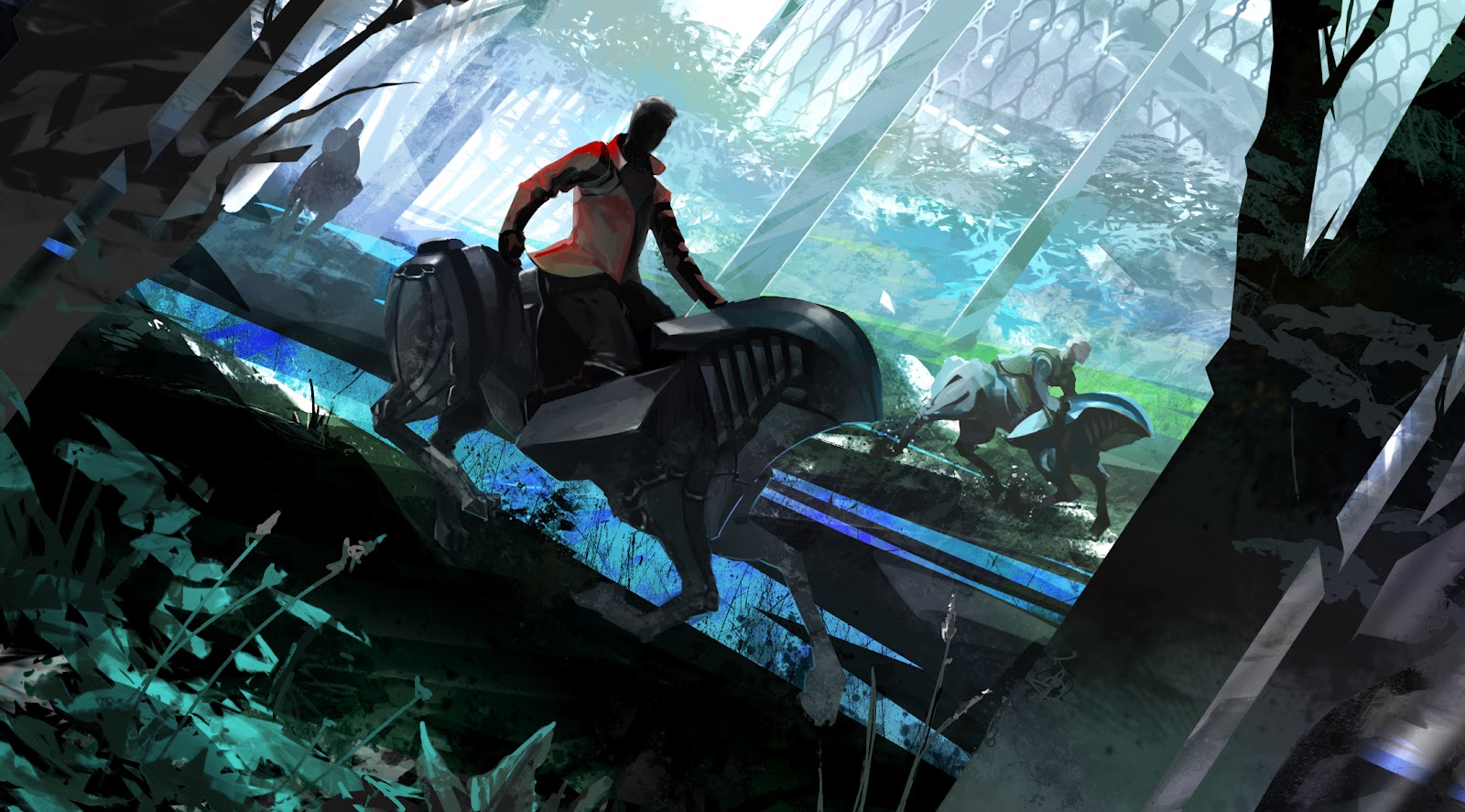
One of the foremost privileges awarded the wealthy corporate nobility is the freedom to close off entire forest floors for a day's hunt astride their synthetic mounts.
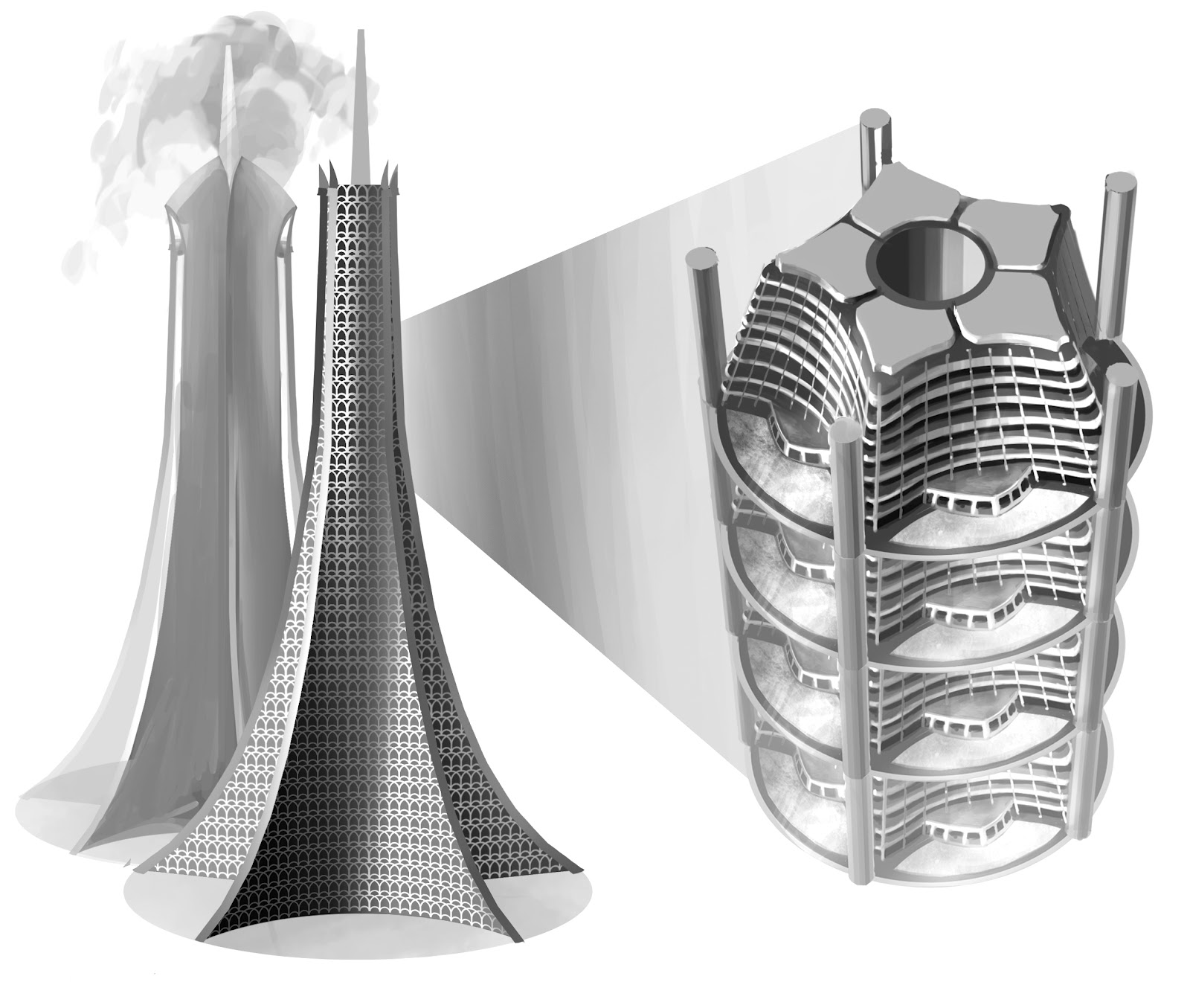
The common towers house pentagonal segments of apartment complexes for the people. Groups of 100 individuals live around each elliptical courtyard, in close-knit and largely self-sustainable communities. The prism spires atop the tall buildings capture light from above the clouds and lead it down the central enclosed pillar.

Here, robotic gardeners harvest crops from circulating hydroponic sails onto conveyor belts that deliver the fresh produce directly to the communal kitchens. A central capillary pump pillar supplies the entire building with water. These stacked greenhouse rooms have a carbon dioxide-rich atmosphere and are generally too warm and humid for human comfort, and so they are sealed off from the population.

A closer look at the division of different-size apartments in each "petal". Bachelor pads are interspersed with neighboring family apartments in order to avoid segregating the population.

An apartment courtyard. It's day outside, and so the windows are dimmed in order to absorb the maximum of sunlight. A substitute low-intensity solar lamp supplies light to the inverted flower meadow in the ceiling as well as to the rest of the room. Tapestry walls replace solid doors, adding to the feeling of trust and familiarity. They are sealed by magnetic strips. Each corner of the gangways house gathering spots with a central hearth/table and overhead holographic projector for those important games of football.

A basic apartment. A central sleeping area surrounded by wallscreens of retractable Memcloth curtains. By utilizing a projected soundfield (ultrasonic waves that give the impression of tactile feedback when they intersect with each other) the user can easily manipulate menus and the like in mid air, in three dimensions.

The bed is dubbed Vacufoam for its ability to retract its mattress and simultaneously suck all of the air out of it. Not only does this allow for a smaller roll when retracted, but eliminates the possibility of bacteria growing in the stored foam mattress.

A courtyard feast on the central platform, looking out across the nightscape of future London as the solar glass can remain clear during the night. Above, the bioluminescent flowers of the inverted meadow glow like a miniature starlit sky.

Rather than keeping pets and children cooped up in the tiny apartments, why not let them play together in the large open spaces of the courtyards?

Finally, here is an example of how the upper classes live. In the full-story penthouses of their corporate spires - complete with green rolling hills, artificial lakes and digital sky domes - they build their own family mansions.

There. It's been a long couple of months of researching and designing and painting, interrupted by pesky school projects all throughout the process, and even a two-week trip to Japan... But I managed. And to tell you the truth, I'm still somewhat amazed that I managed to pass this off as an industrial design project from start to finish.

As it stands, a report full of behind the scenes material is still to be printed, and the whole shebang is to be presented at the school's summer exhibition. But for now, I believe a brief sigh is in order. Phew.

Hope you enjoyed it all, I know I did :)

Thursday, February 16, 2012

Trying out a new set of brushes.

Tuesday, February 7, 2012

The Bachelor project is upon me! Time to expand on the future of London, why not?

I decided to start off with the street fashion of 2150 AD. Not only is clothing an important part of the final vision, but the cuts and patterns of clothing are usually deeply rooted in the form language of their surroundings. Finding a direction now will help me to achieve coherent designs later on.

Some buildings. The main inspiration for it all is medieval times, mainly gothic architecture, armor and of course dragons. The future Londoners will after all call their city 'the slumbering dragon', latent but by no means to be trifled with.

 Different ideas for dealing with the rising water levels of the future - as much as 4 meters by the year 2200.

The basic apartment for London's booming population. Everything you need to survive, a bed, water, toilet, food, storage and entertainment. It might not look like much, but its just enough.

 Structural exoskeletons of ultrastrong nanomaterials replace the normal concrete core of highrises, allowing for a more free placement of interior walls and spaces.

With the city buildings rising ever higher into the condensation clouds formed by artificial photosynthesis, the streets must follow suit in order to keep up with the demand for surface area. Multilevel shopping streets are glassed in to ward against the London rain, and to turn the rain into something enjoyable, the collected masses of downpour are funneled into hanging rain fountains for fabulous displays of falling water.

Friday, January 13, 2012

The coffin hotel used by the protagonist in the beginning of the story. Not to sleep in mind you, but rather as a relatively secure stash for stolen goods pending payment.

Wednesday, January 11, 2012

Recently started reading the novel Neuromancer by William Gibson. Awesome book, awesome early cyberpunk universe. There are some rumors out there hinting at a coming movie, but as of yet, one can only hope. Until then, this is my concept of the Ninsei in Chiba City from the opening chapters.

Saturday, January 7, 2012

A bar and brewery in one. Convenient, wouldn't you say?

Saturday, December 31, 2011

Friday, December 30, 2011

Thursday, December 29, 2011

Wednesday, December 28, 2011

Monday, December 26, 2011

Sunday, December 25, 2011


Some color-exercises: copying screenshots of the movie Gladiator, just for the sheer cinematographic joy of it. Hopefully I will learn something about color and composition in the process.

Wednesday, December 14, 2011


Different hilts.

Originally, the idea was to create a cutting edge using a strand of plasma arcs along the edge of the sword scroll. However, that seemed sort of overkill as fencing is more about pure finesse, finding the cracks in your opponent's armor and striking them precisely, rather than slicing someone in half with a viking broadsword.

The finished concept instead used a coil of metal similar to nichrome, the stuff that toasts your bread in the morning, glowing hot enough (about 1400 degrees Celcius) to cause serious cauterized scars, or even death.

And there we are: the rapier in action.

Monday, December 5, 2011


Couple of hours' worth of  sketching. Not in any way related to the London 2150AD project. I think...

Thursday, December 1, 2011


So how do these groups settle their differences? Car-jousting? Fast-paced games of chess? Well, first of all, to gain satisfaction and restore/defend one's honor one needs to be willing to risk something, something serious, like bodily harm, or even death. Some form of violence seems to be the only real way to go.

Drawing on the rich history of dueling with rapiers, full of finesse and finely tuned badassery, I figured there had to be some way to compress the otherwise bulky sword into a more compact and elegant object. A rolled-up sheet of memory material would be able to elongate at will into a thin needle, and its internal circuitry would be able to form super-heated plasma to provide an edge to the coiled cone. Bulletproof body armor wont help you here - lose this duel and, if you're lucky, you'll be left with your life, and some cauterized scars.


Quick visualization sketch of the early rapier concept in action.

Saturday, November 26, 2011

These are some of the different corporate families, decked out in full protective streetgear.

Thursday, November 17, 2011


This is more like it! 
If our teacher is to be trusted, we will finally be given freer reign over our normally so very constricting projects. A space - a user - a product. In my case: future London - roaming gangs of corporate families - a way for them to achieve satisfaction through dueling on the streets.

Starting off with the space: London 2150ish AD. I tried to give the architecture the feel of ages past while still looking futuristic. The gorgeous Thames flood barrier was a great source of inspiration.


Aerial view of London 2150 AD,
two dense crescents of towering corporate buildings coiled around the old city heart, like a slumbering dragon hoarding its mound of gold. Green solar scales cover most surfaces, further aiding the dragon analogy.

 This is a likely field of battle: a multi-storied shopping street, where the logo-sporting corporate employees might run into each other and pick a fight. 

Maybe there are rumors circulating as concerns a botched hacking attempt directed at corporation A's mainframe, maybe Corporation B feels this an unfounded assault on their honorable trademarked name, tempers rise, words fail, and they resort to a more drastic solution to their argument - dueling.

More to come.


Wednesday, November 2, 2011

Ice cave.
Started out completely blank on this one, mainly experimenting with different textures and with repeated elements, like in the half-buried icicle giant's beard/face/teeth. Time for sleep.

Tuesday, November 1, 2011

New Owl City, streetview.
Another quick and silly piece, adding to the retro scifi madness that is new owl city. It's brutally rough I know, but at least my fingers and brain got their daily workout. The floating wisps of aurora-like bandwidths - having entered into the visible spectrum for the city's inhabitants - appearing so vibrant during the night, now float placidly through the bustle and commerce, like feathery down caught on the breeze.

Monday, October 31, 2011

New Owl City.
Quick and silly piece of practice - inspired by the tranquil image of an owl, and perverted into some futuristic neon fever dream. I simply need to churn out paintings on a more frequent basis, regardless of school work or whatever, else i fear my fingers will wither alongside my imagination. Dear oh dear.

Tuesday, September 27, 2011

A couple of very quick and dirty photomashes to visualize some possible screens of the game.
As school was suddenly back in session, a couple of us got the idea to try and develop a delightfully indie sidescroller set in the early computer age of an alternative victorian London - a variant of steampunk labelled playfully by us as sparkpunk. 

At the centre of this would be the Grand Computer, beset by everything from skittering analog computer viruses to frayed copper wiring snagged in whirring cogs. It is up to you, playing the role of the Assistant, to enter this the technological wonder of our time and Debug it. Quite literally.

That's the main idea, and here's the first character sheet for said Assistant.


After deciding upon a gentleman/mechanic sort of character (merging the 3,10,11,12 initial explorations), these next twelve iterations followed. All sporting some variant of the wearable Faraday cage protecting its wearer from the ravages of the high-voltage inner workings of the Grand Computer.